Original reference photography from the Cola Machines archive. Select any image to inspect the machine, mechanisms, identification plates, and restoration details.
The History of Coke Vending Machines
1920s: The Beginning
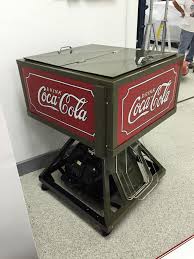
The Glascock Brothers Manufacturing Co. of Muncie, Indiana, is renowned for producing the first mass-produced Coca-Cola cooler and vending machines in the late 1920s and early 1930s. These early machines, including the “Standard” and “Junior” coolers, were primarily ice-cooled and designed for retailers.
They were known for their robust construction and ability to withstand heavy use. Later, Glascock also produced coin-operated vending machines for Coca-Cola
They were simple ice-cooled chests where you dropped a nickel into an honor box and grabbed a 6½-oz bottle.

1930s: More Companies Emerge
By the late 1930s, companies like Vendo, Vendorlator, and Cavalier began producing coin-mechanized coolers that would only release a bottle after payment.
These early machines were still mosty just ice-cooled or water/ice cooled chest before evolving in later years into refrigerated chest and upright units in the 1940s.
1940s: Post-War Innovation
After World War II, Vendo Company introduced their Model 39, featuring improved refrigeration and more reliable mechanisms. The distinctive curved front design became iconic.


1950s: Golden Age
The decade between 1950 and 1960 marked a golden era in the history of soda vending machines—a time when innovation, design, and brand identity merged to create some of the most iconic and collectible vending machines ever made. With the post-war economic boom in full swing, Americans were embracing modern convenience, and soft drink companies were eager to meet that demand. The result? An explosion in stylish, functional vending machines that not only served ice-cold sodas but also became cultural symbols of mid-century Americana.
Click here for a complete history on the Golden Age machines!
1960s: Transition Period
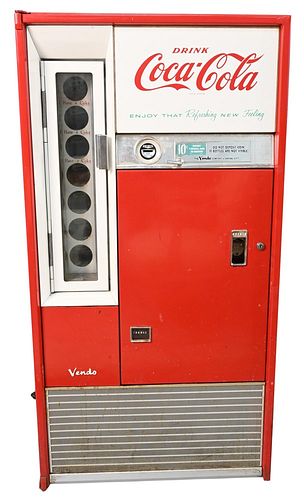
As cans became more popular, bottle machines evolved with larger capacities and typically were square corner designs. The classic red and white color scheme became standardized.

1970s: End of an Era
The 1970s marked the end of the golden age of bottle vending machines. As technology advanced and consumer needs shifted, the industry moved away from these classic designs, leaving behind a legacy of durable, functional, and visually striking machines. Today, these last-generation bottle machines serve as a reminder of a time when soft drinks were dispensed from glass bottles, and vending machines were a charming part of American daily life.
The transition from bottle to can marked the end of one chapter in vending history, but the machines that remained continue to captivate collectors and enthusiasts, securing their place as treasured pieces of Americana.
One of the earliest Vendo models featuring a distinctive curved front and manual bottle dispensing.
Vendo 56
Iconic “slant-front” design with chrome trim and illuminated Coca-Cola signage. Holds 56 bottles.
Vendo 81
Large capacity machine with 81 bottle capacity. Features the classic red and white color scheme.
Vendo 44
Compact model with 44 bottle capacity. Known for its distinctive “bubble” glass front.
Vendo 63
Transitional model between the slant-front and later vertical designs. Holds 63 bottles.
Vendo 110
One of the last bottle machines with high 110 bottle capacity before cans became dominant.
Join Our Collector Community
Network
Connect with hundreds of collectors worldwide to buy, sell, and trade machines and parts.
Knowledge
Access our extensive database of manuals, schematics, and restoration guides.
Events
Attend our annual convention featuring rare machines, expert talks, and auctions.
Membership Benefits
Exclusive access to private sales
Quarterly collector’s magazine
Discounts on restoration parts
Machine authentication services
Valuation assistance
Early event registration
Collector Resources
Restoration Guides
Step-by-step instructions for bringing old machines back to life.
Machine Manuals
Original documentation for various models and years.
Parts Directory
Find suppliers for rare and reproduction components.
FAQ
Answers to common questions about collecting and restoring.
Machine Identification Guide
Use our comprehensive guide to identify your machine’s model, year, and original specifications.